- care@vastumanojjain.com
- 26 Ram Vihar, Delhi-110092, IN

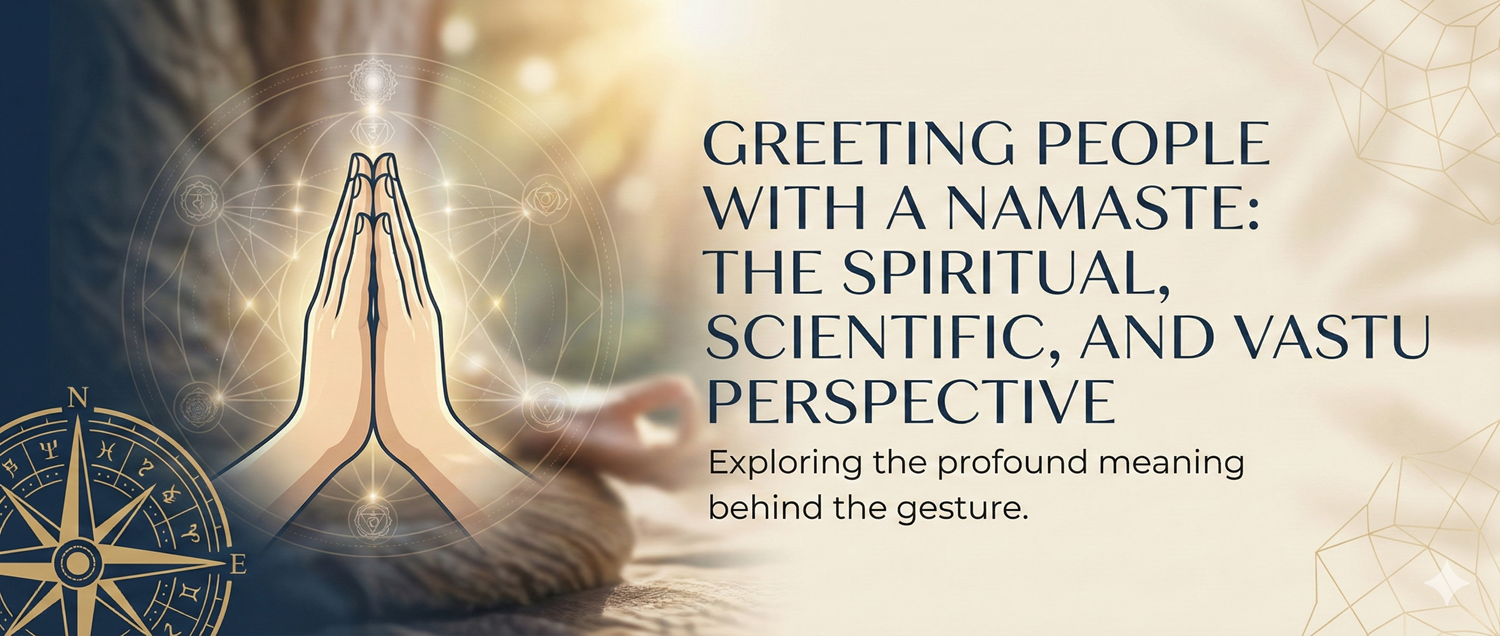
Greeting People with a Namaste: The Spiritual, Scientific, and Vastu Perspective | By Vastu Expert & Astrologer Manoj Jain
11
Dec
In Hindu culture, greeting people with a Namaste is far more than a gesture, it is a sacred expression of humility, respect, and spiritual connection. As Vastu Consultant and Astrologer Manoj Jain, I often emphasize that traditional Hindu practices hold deep philosophical, energetic, and scientific meanings. The way we greet another person reflects the harmony of our inner and outer worlds, and Namaste perfectly embodies this harmony.
In this blog, I will decode the spiritual science of Namaste, its Hindu scriptural significance, its Vastu and energy benefits, and the modern scientific explanation of why this ancient greeting continues to be one of the most powerful gestures in human interaction.
What Is Namaste? Understanding the Meaning and Origins
The word Namaste is a combination of two Sanskrit words:
- Namah – to bow with respect
- Te – to you
Together, Namaste means “I bow to you with respect.”
This greeting reflects:
- humility
- acknowledgment of the divine in the other
- a conscious expression of gratitude and respect
In Hindu Dharma, we greet elders, teachers, gurus, and those with greater wisdom or age by joining our hands and saying Namaskar or Namaste. This gesture is deeply aligned with the spiritual traditions that view every person as a manifestation of divine energy.
The Traditional Posture of Namaste and Its Energy Significance
When performing Namaste:
Both palms are joined, touching completely from fingertips to the base.
The hands are placed close to the chest, directly in front of the Anahata Chakra (Heart Chakra).
Why the Anahata Chakra Matters?
According to yogic and Vastu energy systems, the Anahata Chakra governs:
- love
- devotion
- emotional balance
- compassion
- connection to divine consciousness
When your palms touch and you bow slightly, you activate the energy of surrender and humility. This helps strengthen:
- your bond with the divine
- your connection with the world
- your sense of inner peace
This is why Namaste is not merely a greeting; it is a spiritual alignment of mind, body, and soul.
Scientific Explanation: What Modern Science Says About Namaste
While Namaste has strong spiritual roots, it also has scientifically measurable benefits.
1. Activation of Acupressure Points
When we press the fingertips together, the pressure stimulates acupressure points connected to:
- eyes
- ears
- brain
- nervous system
This activation helps in:
- improving memory
- enhancing focus
- sharpening sensory awareness
2. Positive Energy Activation at the Heart Center
Placing the joined hands near the heart activates the Anahata Chakra, which according to yogic science leads to:
- emotional stability
- radiating positive vibrations
- improved communication and body language
This is why people who greet with Namaste often appear calmer, grounded, and more composed.
3. Hygiene Benefits: A Safer Alternative to Handshakes
Scientifically, Namaste eliminates the exchange of germs that commonly happens through:
- handshakes
- hugs
- physical touch greetings
This makes Namaste one of the most practical and infection-safe greetings in today’s world.
Namaste in Yoga and Meditation: The Science of Alignment
Many Yoga Asanas incorporate the Namaste gesture (Anjali Mudra) because it:
- balances both hemispheres of the brain
- reduces stress
- enhances concentration
- aligns the body’s energy centers
This is why yogis begin and end their practices with Namaste — it symbolizes gratitude, surrender, and energetic unity.
Vastu Shastra Perspective: Why Namaste Creates Positive Aura
From the viewpoint of Vastu Shastra, the way you greet others influences the energy flow (Prana) around you.
By using Namaste:
- you generate positive vibrations
- you maintain an energetic boundary
- you prevent negative energy exchange through touch
- you invoke the divine presence within you
This makes Namaste an auspicious gesture that supports emotional harmony and spiritual protection, aligning perfectly with Vastu principles.
Namaste and Astrology: Strengthening Personal Aura and Planetary Influence
As an astrologer, I have observed that individuals with strong Moon, Venus, and Jupiter energies naturally gravitate towards gestures like Namaste, which enhance:
- emotional sensitivity
- compassion
- spiritual inclination
- humility
Practicing Namaste regularly can help balance:
- Moon (mind)
- Venus (love and harmony)
- Jupiter (wisdom and respect)
Thus, it becomes not just a greeting, but a remedy for nurturing inner calmness and positive aura.
Why Namaste Should Be Practiced Daily
In a world full of distractions, Namaste reminds us of:
- mindfulness
- respect
- spiritual awareness
- cultural identity
- energetic purity
Whether you are greeting a family member, a teacher, a guest, or a stranger, Namaste radiates warmth and positivity that strengthens human relationships.
Conclusion: Namaste - A Bridge Between Science, Spirituality, Vastu, and Hindu Tradition
Namaste beautifully blends the wisdom of Hindu Dharma, the precision of Science, and the energetic harmony of Vastu Shastra. As Vastu Expert & Astrologer Manoj Jain, I encourage everyone to adopt this powerful gesture in daily life to cultivate positive energy, strengthen emotional balance, and honor our timeless cultural heritage.
For more insightful blogs on Vastu Shastra, Astrology, Hindu culture, and spiritual science, visit: